Monday, May 16, 2011

More thoughts on the "Good Shepherd"

Readings for the day:
Acts 11:1-18
John 10:11-18


This past weekend we celebrated "Good Shepherd Sunday". So named because the Gospel for the day is Christ's discourse, related in the Gospel according to St. John, on the good shepherd. This is used by the Church as a particularly good time for encouraging vocations. It isn't for no reason that Pope John Paul II named his post-synodal apostolic exhortation Pastores dabo vobis - I will give you shepherds.

It occurred to me, as I listened to today's first reading, that what is missing today is a trust in today's shepherds when it comes to teaching and discipline. In today's reading Peter is challenged by the Jews regarding his activities with the gentiles in Ceasarea. But after he explained his vision and the actions which followed they rejoiced!


What a far cry from what happens today. The Holy Father, or a good bishop in communion with him, does something, makes a judgement, writes a letter, etc., and he is subjected to immediate questions and judgement. Now, as we saw in today's reading from "Acts", questioning the actions of our pope or bishop is not, in itself, a bad thing. In fact, given many of the things that have gone on over the years, it's probably a good thing. However, once the explanation is given we should also be rejoicing!

Sadly, we don't rejoice. There is always someone to question every aspect of the pope or bishop's decision. Some gripe that he didn't go far enough. Others gripe that he went to far. And from there all kinds of over broad and grandiose, or on the other hand - dismissive statements are proclaimed.

This "magisterium of the individual" is something that I have experienced with priests (and bishops not so in-communion with the pope) and laity alike. Whether it is principles of theology, prudential applications of moral theology, or disciplines of the Church (liturgical, moral, and otherwise) someone always seems to know better. Ugh!

How about we stop passing judgement on our pope or bishop's teaching or decisions and, after asking questions which will lead to understanding, REJOICE??? I am certian that it would lead to not only greater peace within the Church, but also a more wonderful witness to the power of the Spirit acting in the Church today just as it did in the time of the Apostles.

You don't care for the extraordinary form of the Mass? Then don't celebrate it. But don't criticize those who do! You think something is missing in the ordinary form of the Mass? Then go to an extraordinary form Mass and rejoice that whether it is the ordinary form, the extraordinary form, the Eastern Rites, or the Anglican usage, we are all one body in Christ!!!

Be sure, there's stuff that I'm not so thrilled about either, but what the Church allows is not to be dis-allowed. I might also add that what the Church dictates is not to be "bitched" about (even if it involves moving yet another holy day to the nearest Sunday :)).

So, as we celebrate this week following Good Shepherd Sunday, let us be sure to give thanks for our good shepherds. Also, hold them up in prayer daily. Lord knows I don't get through a week but for the prayers of so many faithful and loving people. Amen!I'd have one of Bishop Callahan, whom I love dearly, but I don't have one and couldn't find one. Next time!

Saturday, May 14, 2011

Good Shepherd Sunday - World Day of Prayer for Vocations

It is Good Shepherd Sunday and World Day of Prayer for Vocations. Here's a link to my parish letter for this weekend which is a little reflections on the crisis in priestly vocations.

Wednesday, May 11, 2011

New English Translation of the Mass

At the expense of exposing myself as a total ignoramous, I'd like to commend to all the Roma Locuta Est blog. The author has been doing an excellent job of writing little commentaries on the parts of the Mass and their new translations. Particularly valuable is his knowledge of Latin grammar and his analysis of the new versus the old. I also appreciate his insights as he applies what might be called a literary analysis to the texts. Let me know what YOU think about his contributions. I'm interested in hearing from others.

Friday, April 22, 2011

Good Friday - Stations of the Cross

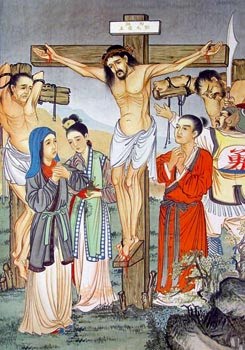
There is a great page at the Holy See's website which makes available the Stations of the Cross used by the Holy Father for his annual celebration at the Coliseum in Rome. The Stations are written by a variety of people over the years. They are available in English back as far as 2000. Before that you'd better know Italian. Also, there are pictures accompanying the stations from a variety of sources. The picture at left is from the 12th Station in 2008 which meditations were written by the Archbishop of Hong Kong. Note: the stations are not always the traditional 14 that we are used to. There are always 14, but sometimes they take up other moments from scripture in the Passion of our Lord.
This is one of those resources which really makes for some good prayer over Good Friday and even into Holy Saturday Morning. Enjoy!

Sunday, April 17, 2011

Liturgical Music

Some of you may know that I started out life a musician. I hold a bachelor's degree from the University of Wisconsin - Eau Claire in vocal music and I started playing the organ in my parish church at the age of 13. My passion has always been sacred music and especially liturgical music. I have read pretty much all of the Church's legislation and teaching on sacred music and have wondered long about why we have so little that truly serves the liturgy well. I even "wasted" an hour the other day listening to GIA's offerings on settings for the new English translation of the Mass. I was starting to wonder if I wasn't getting too "old and stodgy" in my musical tastes when I spoke to a talented young organist from the Twin Cities (Minnesota) who confirmed what I was thinking: it really is difficult to find truly worthy music in English, especially for non-urban parishes.

So, it was with great delight that I read, this past week, the comments by Joseph Cullen, choral director of the London Symphony Orchestra. In the article found on CNA's website He said that since the 1960's there has been a "glaring lack of sympathy for worthy sacred music." He went on to say that "the rush to find new musical settings for the Novus Ordo mass in the 1960s led to little artistic scrutiny being applied to the process. As a result, he says, most parish Masses now have poorly composed hymns being used inappropriately as mere “filler” throughout the sacred liturgy." How right he is!!! He also commented on the inappropriate use of familiar melodies and what I call "the attack of the voice", aka: cantors. Check out the article in its entirety here. You won't be sorry.

I must say, I particularly like what he had to say regarding the faulty approach used by the sacred music organs within nation conferences of Catholic Bishops. Things about which I have grumbled for a good many years.

It was a delight also to see another article in which Scottish composer James MacMillan echoes Cullen's criticism in another CNA article. Is it too much to hope that somebody out there will listen during the reign of a pope with the refined tastes and experience of Pope Benedict XVI? We shall see....

As with many things in the Church, it is not a matter of needing the teaching and legislation on these issue clarified. It is a matter of truly competent people being put in place and given the exposure necessary to get good music out to the parishes. It is also a matter of composers giving us material that doesn't require a cathedral choir to present.

Of course, a new English chant tradition would certainly be of great help in applying the Church's rich tradition of psalm singing. Maybe the new Anglican use ordinariate will be of help in this regard? More hymnody with texts which serve the liturgy and reflect the given antiphons of the Church would also be most welcome.

Anyone have sources they'd like to share? Share away so that we can all benefit. I might make a start with the Church Music Association's website - Musica Sacra.

Happy Birthday Papa!

Birthday wishes to our Holy Father, Pope Benedict XVI. I've been an avid reader of Pope Benedict's books for 20 years now. He is a true "great one". His 2nd installment of Jesus of Nazareth is a fantastic companion to Holy Week. God willing, he will be able to finish up the third volume and maybe a few more encyclicals - maybe something surprisingly mundane to the "experts", possibly on faith? :) In any case, blessings on our Holy Father!!!

Friday, January 21, 2011

Agnus Dei...miserere nobis!

Saturday is declared, by the Catholic bishops of the United States, a day of penance for the sin of abortion as we come upon this sad commemoration of the U.S. Supreme Court decision legalizing the abominable scourge that is abortion. What will you do in reparation? Might I suggest, in addition to your prayers and fasting (or at least abstinance from meat) that you seriously consider sending off a letter/e-mail/phone call to your state legislator and/or your congressman and senators expressing your support for their pro-life votes or encouraging them to open their hearts to the unborn and their mothers.

There are some numbers that have been running around in my head over the last several days along with a couple of truly shocking news stories. The first number is 4,408. This is the number of soldiers who have died in Iraq since 2002 (8 years). I know that many have wondered if that is acceptable. Of course, we then consider that in all of the wars since the foundation of our country we have lost 1,010,003 men and women. Rightly so, we set aside a number of days each year to memorialize these brave men and women.

I thought next of those who die from the three most talked about medical conditions. According to the US Centers for Disease Control these are the numbers for 2007: Men who died from heart attacks – 206,800; Women who died from breast cancer – 40,598; All persons dying with an AIDS diagnosis – 18,089.

Then I thought of the number of traffic deaths. It turns out that there are about 40,000 traffic deaths per year in the United States. The total since 1973 is about 1,646,486 deaths.

I thought about how much time and effort we put into becoming aware of these issues. The NFL, for instance, has an entire month where players and coaches incorporate pink into their uniforms in order to bring awareness to breast cancer. I still see billboards that proclaim the need to fight the “epidemic” of HIV/AIDS. I recalled how much effort is put into making our young people aware of just what kind of damage an automobile can do to them and those they love. We even consider it important sometimes to confront them with the horror of images of the aftermath of deadly auto accidents.

Yet, all of this pales in comparison to that for which our society fights tooth and nail and even tries to characterize as a constitutional right – abortion. PLEASE, don’t stop reading. I know many don’t want to hear it, but this is too important.

Since 1973 there have been about 50 million “safe, legal” abortions in the United States where our Declaration of Independence tells us that we “are endowed by our creator with certain inalianable rights, among these being life, liberty and the pursuit of happiness”. In 1973 we were told that it was nothing more than a “blob of tissue”. In 2011, in the face of ultrasound images, we are simply told that it is a “choice”. This breaks down to 1.2 million abortions per year (a little more than the total number of war dead since 1775); There were about 137 abortions performed in the time it took you to attend Mass; there have been about 7 abortions in the time it has taken you to read this article thus far.

For over 30 years we have been told that it is important to make abortion “legal, safe, and rare”. Two weeks ago it was reported that 40% of all pregnancies in New York City end in abortion. So much for “rare”. Last week we read about an abortion provider (can’t bring myself to call him a doctor) arrested for the deaths of a woman and 7 newborns. So much for “safe”. The only thing we can say about abortion is that it is legal. That doesn’t make it morally right in the eyes of God.

There is so much more that could and needs to be said. However, I will leave you with this for now. Archbishops Dolan and Listecki, and our own Bishop Callahan have made it clear that this is THE moral, social justice issue of our time. If we don’t get this right, there is nothing that can truly be made right. Please, join me in prayer, fasting, and charity that we may put an end to this modern day holocaust.

Saturday, January 15, 2011

Why do Catholics do that?

This was written as a catechesis to my parishes in rural western Wisconsin. I thought that it might be interesting for others, so hear it is. Enjoy!

As we prepare for the new English translation of the Mass, which we will begin using on the first Sunday of Advent-2011, it seems good that we first take a look at those things which are not going to change, but either were not implemented very well back in the 70's, or have fallen into disuse through inattention or what have you.
We have to remember that we are BOTH body and soul. This is an important consideration when we look at why the Mass is structured the way it is and why we do what we do. What we do with the body supports and reinforces that to which we give ascent with our minds. This includes all of our senses of sight, sound, taste, touch, and smell.
It is really quite wonderful and our knowing these things can help us in entering into our worship of God even more fully. So, here we go...
Why do Catholics stand, sit, kneel, up & down, back & forth? My Lutheran friends have called this "Catholic Calisthenics"! Yet, there is an important reason for why we do these things.
Standing is an attitude of attention, preparedness, and honor in our culture. When we are greeting or addressing someone of importance we stand. We also stand when we are being particularly attentive. And, we stand when we are acting in a particular way as "one body" - hence, the saying "stand with me".
All of these issues are active at one time or another during the Mass. When we begin the Mass, we "stand together" as one body in Christ. We are also standing as a sign of respect as we present ourselves to the living God. We likewise stand at the end of Mass when we are taking our leave of Him. At the same time, we are preparing to "go forth" as we are sent to be the united Body of Christ acting in our world.
During the Gospel we stand at attention so that we may be prepared to more fully receive the words of the Gospel. We recognize that the words of the Gospel are special, they have a different character than the other readings. Thus, we want to be especially attentive so that we may receive these even more fully.
We also stand, especially in prayer, because it is at these times that we are exercising our common priestly service to which we are all called at Baptism. Thus, the whole priestly congregation stands before the altar of God offering prayers of praise, thanksgiving, supplication, and petition in union with Christ, of whose body we are all members, and who is sacramentally present in the person of the ordained priest.
Sitting is a whole lot easier to understand. When we sit we are a little more relaxed. We are in an attitude of rest, at least for the moment. We are also in a position of receptivity for that which is going to take a little longer to receive - multiple readings and the homily!
Kneeling is one of those things that one only sees in Catholic or Orthodox Churches. Of course, that makes sense since it is in a Catholic or Orthodox Church that one comes into the presence of the "Word made flesh" - Jesus Christ, in his Body & Blood, Soul & Divinity. Yes, when we are kneeling we are in a position of ultimate respect, awe, and submission.
When one believes that they are truly in the presence of God, it is right and proper that we would be on our knees. We need only see the example of the disciple Thomas when he sees Jesus in the upper room after the resurrection, and of the "beloved disciple", St. John, who falls not only on his knees but on his face (that is, fully prostrate) when he sees Jesus at the beginning of the book of Revelations. This is also the position taken by Moses, Daniel, and others in the Old Testament when confronted by divinity.
We don’t just attest to the presence of God in our midst, of Jesus Christ in the Eucharist, with our minds and hearts, but with our mouths and our whole body. Thus, it is appropriate that we should kneel in these situations.
Genuflecting is like kneeling, though of a shorter duration. It is, again, a sign of respect and submission to the divinity of God. I know that sometimes we have a problem with submission, however, it is good and healthy for us to remember that "if we can kneel before God - we can stand before anyone!"
It is also an act, during the Masses of Christmas, in which we demonstrate the mystery we are celebrating. At Christmas we celebrate the eternal Word has come to earth and taken on our human flesh. Our human flesh, according to the creation story in Genesis, comes from the dust of the earth. Thus, during the Creed, in genuflecting - touching our knees to the dust of the earth - we demonstrate the Word "coming down" and "taking on our flesh". Outside of the Masses of Christmas we bow rather than genuflect. However, we should do so with no less reverence. In this act we carry throughout the year the lesson of that which we celebrate at Christmas.
The "Confiteor" is the prayer in which we set the stage for our worship of and coming before God. We recognize that we need God precisely because, as sinners, we cannot accomplish anything truly good or lasting on our own. This is why we are instructed to "strike the breast" at the words "I have sinned through my own fault". Over the last 40 years this was reduced to one strike with the reduction in text. However, with the coming of the new English translation of the Mass we will return to the formerly familiar - "Through my fault, through my fault, through my own most grevious fault." With this will come a return to the three fold strike of the breast. But WHY strike the breast at all???
You will recall that the way of banishing evil from the community in the time of ancient Israel was by way of stoning the vessel, the person, in which the evil resides and thus enters the community. In balling up our hand into a fist we make of our hand a stone with which we beat out the evil that resides in our own heart. Thus we demonstrate in a physical way that which we are saying in the prayer.
Why is this so important? Well, you’ve heard me say many times that one of the first conditions for being a Christian is to be and recognize the fact that we are sinners, in need of God’s divine mercy. In making this physical gesture we remind ourselves of why we are here and why it is important that we be here.
"Smells & Bells"
During the 70's - 90's we stripped our worship of many things that were quite distinctively "Catholic" in American Christian worship. Sadly, along with leaving these things behind we left behind the sense of wonder and awe that ought to accompany the worship of God. Of course, maybe that is part of the reason that these things went away. As we will discuss later, with regards to music, we made a sad transition from worshiping God to celebrating ourselves, with a nod to God - and doing it as quickly as possible.
In the last few years you will have noticed that bells have not only returned to Catholic worship, but their use has increased even in those parishes where they never left. So, why are bells used? What do they signify?
It turns out that bells are very helpful. First of all, they recall and focus our attention at a time when something important is occurring. The first bell, which has returned after a long absence in most parishes, calls us to attention at the epiclesis. The epiclesis is the "laying on of hands", that ancient sign of calling down the Holy Spirit on some person or thing. Thus, at the epiclesis in the Mass, the Holy Spirit is called down upon the gifts of bread and wine as we implore God to take these gifts and turn them into the living Body & Blood of His Son, our Lord, Jesus Christ. That is certainly something we would want to be attentive to, especially since we are called to unite our thoughts, prayers, and intention with that of the priest who offers these prayers on behalf of us all.
The bells are heard again at the consecration of the bread and then of the wine. These bells call us to adore Christ who has again come among us in living flesh and blood. It is because the host and cup are now the Body & Blood of Christ that there are three rings of the bell.
I recall reading about how St. Elizabeth of Hungary was so grateful for these bells because as a young bride she had a habit of getting lost in her thoughts regarding the love she had for her husband - Louis. It was the bells that brought her back to where she needed to be. I am also reminded of the blind man who related how distressing it was for him when his parish stopped using bells because it was the bells that let him know that the consecration was happening. So we see, even on a practical level bells are a very helpful part of Catholic worship. On a spiritual level they assist as they again engage our whole body in worship of God who desires to be among us so that we can be with Him.
The smells are often a very difficult matter, especially in these modern times of ours. The time was that folks habitually spent a lot of time in smoke filled rooms and so incense was not really much of an issue. In our modern times it becomes an issue because we just aren’t used to smoke. However, it is still an important part of worship since it again engages our senses and brings to life so many biblical images of the divine presence in heaven and of royalty here on earth.
The magi brought gifts of gold, frankincense, and myrh. As you will recall from the carol sung on the feast of epiphany, frankincense "bespeaks a deity nigh". It was the tradition of many peoples to burn incense to honor a God. Incense was burned in many ancient temples and was made from a number of things from sweet smelling woods (especially cedar) to dried flower petals, to the gum known as frankincense.
Incense is spoken of in the psalms as representing our prayers rising to God. It is spoken of in the book of Revelations as coming in clouds around the divinity of God. So we see that incense serves a double purpose of giving us a visual sense of our prayers rising, as well as a sense that the divinity is among us.
The sweet and pleasant scent is a further reminder of how our prayers are an offering which is "sweet" to God and a demonstration that God’s own presence among us is sweet, that is, wonderful.
Of course, as I noted above, many people do not consider incense to be particularly "wonderful" today. Thus, I have tried to be considerate by not using incense nearly as often as I would like. I have also made sure to only purchase the purest incense so that impurities will not create smoke which chokes. And finally, Incense is never used on Saturday night (with the exception of Holy Saturday, in which case incense is not used on Easter Sunday) and the fans are always going when incense is used so as to disburse it as quickly as possible. In this way, those who are truly bothered by incense may have a Mass at which they can truly worship without the difficulty of dealing with their aversion to incense.
I would note, out of further interest, that I use frankincense for celebrations of God and myrh for funerals. Again, you will recall from the carol and from biblical references that myrh is the traditional perfume for burial.
I hope that this explanation of "why Catholics do that" will help all to enter more mindfully into our shared worship of God. In worshipping God mindfully we worship Him more fully and also allow ourselves to enter more fully into His presence. Why did God give us bodies and souls? So that we could worship Him body and soul. This is made all the more obvious when we recall our expectation that our bodies will be resurrected from the grave and raised to heaven, even as Christ was resurrected on that first Easter. So, we see, we are intended to worship God body & soul, both in this world and in the next.

Saturday, January 8, 2011

Feast of the Baptism of the Lord

This is a link to my weekly letter to my parishioners. It is a call to action regarding the need to encourage vocations. I hope that it is helpful.

A Reflection On My Vocation to Priesthood

The following is a reflection included in my parish bulletin for the Feast of the Baptism of the Lord / Vocations Awareness Week.
I will never forget my bus ride to Columbus, Ohio to begin my first year of seminary formation. Between Chicago and Valparaiso I sat next to a women who engaged me in conversation. In answer to her question about why I was going to Columbus I explained that I was beginning studies to become a Catholic priest. Of course, the usual conversation ensued about religion. But what is memorable about the conversation was her parting comment. She said: “You’re such a nice young man. It’s too bad you’re going to waste your life as a priest. You’d make such a good husband.” Uff-da!
One of the things I have come to realize is that in no way, shape or form do I feel that I have wasted my life. After my first ten years (over half of which I have spent in my current assignment) I can say in all honesty that I am glad that I first heard and then answered God’s call in my life.
To be sure, this life isn’t what I chose for myself! I was open to the possibility (mostly), but it was not something that I pursued of my own choice. So, how did I come to hear and answer this call?
First of all, from the time that I was young, my parents made it clear that GOD COMES FIRST. I can actually count on one hand the number of times we missed Mass in my first 18 years of life. We were active in our local parish, but more importantly, my parents modeled a life of charity in our local community. We were also taught that because Church is important, being a priest is a worthy way in which to spend our lives.
As I went through junior and senior high school I got sidelined (maybe inevitably?) by those incredibly attractive creatures known as females! As God designed, I really became attracted to the idea of marriage and children. No doubt my parents were somewhat disappointed that I seemed to have left behind the idea of priesthood, but time would confirm that their patience and prayer was to be rewarded.
As I began life as a college student I continued in the habits my parents had cultivated of being active in my local parish. In fact, four months after starting school in Eau Claire I had a job playing organ for one of the local parishes. It turned out that I had to take a humanities course and so I chose an Old Testament scripture course. A few weeks later my room mate predicted that I’d become a priest. I told him that he was crazy! However, my parents taught me well. My ears were open and even though I was very happily dating God called to me during Mass one day. I bartered, I kind of tried not to listen. However, two things my parents and parish priest had taught me kicked in at this moment: 1) obedience; and 2) God wants you to be happy. So when He calls, it is out of love and a desire that you be as happy as possible.
Of course, there were plenty of people who shook their heads at this. More than once I heard as a refrain the words of that lady on the bus. However, I came to realize, as I pondered what they had said, God want those who will be “Father” to his children to be loving and respectful towards women and children. As I’ve come to ask parishioners: what kind of priest do you want in your parish? What kind of man do you want pastoring your wife, your sons and daughters?
Some people ask if I don’t get lonely living alone. To this I answer that there is a different between living alone and being lonely. I interact with people on a pretty intense level most every day. As a result, I relish the time that I can be “alone” with my greatest love—God.
You see, if I am to give witness to the relationship to which God invites us I must be fully engaged in that relationship. As we’ve discussed, this takes time, just as it does in a marriage relationship. That means lots and lots of heart-to-heart communication with God (aka: prayer).
Also, if I am to serve God’s people well I need to be fully immersed in the Gospel I have been called to preach. I also need to be attentive to the teachings of the apostles (our Holy Father, and our bishop) so that I will know what the issues are that I need to be addressing. Finally, I need to know the issues that affect the people to whom I have been sent. That means studying the news carefully—be it agricultural issues, politics, moral issues of the day, or business trends—if I am to effectively engage the people to whom I have been sent, I need to know more than just a little something about what is affecting their lives. These mean averaging a couple of hours of reading each day.
Of course, we are called to relationship with God and with one another. That means getting out and being with the people to whom I have been sent. With two parishes/schools and the several other responsibilities that go with modern parish/diocesan life I don’t get to do nearly as much of this as I would like, but I certainly try and I appreciate your invitations to your homes and to those events which are important to you.
As you’ve heard me say many times, I am very happy that God called me to serve Him and you as a priest. I hope that this is evident in my attitude and joy. I also hope that it gives you confidence to encourage the young men in your life to keep their ears open for God’s call in their lives—and to answer when He calls. They, and you, won’t be sorry. I can guarantee it!

Tuesday, January 4, 2011

Something worthy of consideration...


"Do not become utterly absorbed in activism! There would be so much to do that one could be working on it constantly. And that is precisely the wrong thing. Not becoming totally absorbed in activism means maintaining consideratio -- discretion, deeper examination, contemplation, time for interior pondering, vision, and dealing with things, remaining with God and meditating about God. One should not feel obliged to work ceaselessly; this in itself is important for everyone, too, for instance, every manager, too, and even more so for a Pope. He has to leave many things to others so as to maintain his inner view of the whole, his interior recollection, from which the view of what is essential can proceed.”
--Pope Benedict XVILight of the World, with Peter Seewald


I can hardly wait to get my copy of our Holy Father's latest book. The above is such a gem! It reminds me of Blessed Mother Teresa's reply when someone criticized her for not using her fame and influence to "do more". This person suggested that instead of "wasting" her time gathering up the poor off of the streets of Calcutta she should be out raising money and then building big hospitals and other facilities that would help many more people. Mother replied that that was not God's way. Her place was precisely in the streets of Calcutta loving "one person at a time" and caring for them.

This often crosses my mind just as I get busiest. I always try to remind myself that one can be busy, busy, busy every day - all day. But, "if I have not Love, I am but a clanging gong." Useless to God's purpose.

So, let me be God's tool, not my own or anyone else's. Let me be completely in love with Him and let our love spill out on all of those with whom I come in contact. This will only happen if I am completely grounded in Him. May I, and all of us, keep this solidly in mind and truly change the world - one heart at a time.

Monday, January 3, 2011

Epiphany

This weekend we celebrate the Feast of Epiphany. When we celebrate a feast year in and year out two things become very important. The first is to instill in our children the story. I hope that as we have all celebrated this Christmas season we have all opened our bibles at home and read to our children the story of the visit of the Magi, along with the rest of the Christmas story. Just in case you haven’t had a chance yet, the story of the birth of Christ is found in the Gospels according to Sts. Matthew and Luke. The story of the Magi is found in Matthew.
I recall being quite scandalized, some years ago, when a group of children I was teaching didn’t know the real story of Christmas at all – apart from Jesus was born and Mary is his mother. If the soil of our children’s hearts, minds and souls is to be prepared for belief the story must be known at least as well as the storyline of their favorite movie. So, please, if you haven’t already done so, sit down as a family and share this wonderful story of God’s love and favor.
The second important thing that we do when we celebrate this feast is become a part of the story. That is the difference between celebrating something that happened 2,000 years ago and something that is continuing to happen in our midst as a continuing act of God’s love and favor. We become part of the story when we recognize and act, that is, participate in the essence of the story. So how do we participate in this story? Well, that is going to depend on where we are in life and who we are. Some things are going to be different for each person, others are going to be common to all of us.
We start, as small children, by coming to know the story well and making the story a part of our lives by keeping it in our hearts. This must be the beginning, of course. How else can we reflect on it and begin to mine its riches? So, please, make sure that first part happens with your children, grandchildren, even yourself.
As we get a little older we begin to make very practical moves towards participating in the story. It may be little “gifts” we bring to baby Jesus such as a renenewed commitment to praying every morning and night. It may be a promise to be more kindly towards family members. We just call to mind the song of the Little Drummer Boy, maybe even listen to or sing it as a family. In this we learn that our gifts to our new-born king need not be big, flashy and expensive. We give what we have. The greatest gift is the gift of ourselves.
As we get older still, we begin to have the capacity to see that we serve Christ in our brothers and sisters. We are most fortunate in our parishes to have this opportunity through our “Giving Tree” (St. Boniface) and our “Baby Shower” (Holy Family). In these we recognize the “baby in the stable” among us and seek to serve our new-born Lord in them. I am quite proud as a pastor that these efforts just seem to grow and grow. It is a good sign that the love of God is indeed to be found in our hearts. Of course, the love of God extends to the unwanted as well. And so, when it comes to welcoming and preserving the lives of all children, especially the most vulnerable among us will we be like Mary & Joseph and welcome the children God chooses to send us? Or will we be like Herod and see that child as a threat to our position, something to be destroyed at all costs? Will we be like Herod’s soldiers and become complicit in this crime against God and His love? Or will we be like the Magi and do even the little we can to protect that life? Our choice is our answer to God’s invitation to be a part of the story – a part of His eternal family.

Saturday, November 27, 2010

Advent begins!

My bulletin letter for this week is some encouragement on the observance of Advent. Enjoy!

Vigil for Nascent Life

Our Holy Father, Pope Benedict XVI, called for a Vigil for Nascent Life to begin the saeason of Advent. And so, we did! There were a number of options but they were more for those who don't already have Mass. So... At Holy Family - Arcadia and St. Boniface - Waumandee, we prayed a pro-life rosary before Mass then after Mass we exposed the Most Holy Eucharist and offered prayers for life and in reparation for the sin of abortion. We closed with benediction.

If you were not able to participate in the celebration at your parish, or if your parish did not observe this vigil, you can still do so in your home and with your family. Pray the Joyful Mysteries and add a prayer for the unborn, for mothers, fathers, doctors, and in reparation for the sin of abortion, fetal stem cell research, IVF, and medically challenged children at the beginning of each decade. Here is a link for some prayers to use in a pro-life rosary.

One of my parishioners commented on how nice it was to pray for the unborn as opposed to hearing about how wrong it is. I would agree! It was wonderful to do this. Maybe we can do a repeat come January. In any case, it is important to hear from your priest that it is evil. It is also VERY important for all people of good will to pray, and pray regularly for an end to this scourge.

I'd like to encourage all to make this your special prayer throughout this Advent season. I would also like to encourage devotion to the Infant Child Jesus (aka: the Infant of Prague). Maybe you could buy a statue of the Infant Child for your parish and ask your pastor to mount it some place suitable within your church. Provide holy cards with an image of the Infant Child along with a pro-life prayer of reparation for distribution in your parish.

There is so much that CAN be done. It's just for all of us to get out and do it. Don't forget to organize letter writing campaigns to our representatives, and not just those who are pro-choice! Our pro-life legislators need to know that we are behind them. Let them know that you appreciate their stand.

May God bless you as you continue to fight the good fight for these modern day "Holy Innocents". May the ever-virgin Mary, Our Lady of Guadalupe, and protection of the unborn, continue to hold you in the fold of her mantel, close to her most Immaculate Heart.

Pray Well!

Sunday, November 21, 2010

Many Blessings on Raymond Cardinal Burke!

I've seen many stories, blog posts, etc. regarding this weekend's consistory wherein Cardinal Burke received the "red hat". That is all wonderful and I am certainly among those who is proud of this latest recognition for "one of our own". However, I want to share a few thoughts that go beyond "local pride" and the "we always knew" pronouncements. Cardinal Burke has gotten where he is because of deep faith, hard work, profound humility, and great fortitude.
Cardinal Burke didn't get to where he is by "making all the right political moves", or by knowing which winds to follow. He is not of the party of the left, nor of the right. Cardinal Burke belongs to the party of the Lamb.
One thought that came to mind over and over again, as the significance of the Cardinal's crimson vestments was explained, was that Raymond Burke, Fr. Burke, Bishop Burke, Archbishop Burke had already amply demonstrated his willingness to give himself completely to Christ and the service of His Church. In the many years I have known him, Cardinal Burke has always been about the glory of Jesus Christ and His Church. Because he, himself, believes so profoundly in the goodness, truth, and beauty of the Gospel, Cardinal
Burke has always sought to draw others to the same Jesus Christ who fills him so wonderfully.
Does this mean that his every move was perfect? That is for God to judge. However, Cardinal Newman's quote regarding the intention to serve well fits Cardinal Burke to a tee. At once it recognizes that mistakes may be made. It also recognizes that these can be forgiven and perfected as long as our intention is purely to do God's will as best as we can know it.
Cardinal Burke's fortitude has always been in inspiration to me. He knows what it is to which God calls us and never shrinks from proclaiming the truth in charity. In season and out of season, no matter the political consequences or the way the liberal press would portray it, he has always told the truth. He has always proclaimed the Gospel.
I have several times told people that it was easy, in some ways, to be a pastor under Cardinal Burke. There was no question about where he was and where he wanted you to be. Even when it seemed that everything was crashing down around me, I could follow his lead in confidence because not only did I know where he wanted me to be, but also why. Not just that, but it was always clear that what we are about is proclaiming the Gospel.
Cardinal Burke's humility is the gold standard. It is obvious to anyone who really knows him that he is a man of humility. He is not afraid to be critiqued. He does not need to be recognized nor has he ever been the kind of man who is looking for the next promotion. His moves were in response to obedience, not self promotion. His gaze is always on The Other, and others - not on himself.

Cardinal Burke has always been an inspiration to me. When I get the chance to see him in two weeks and I kiss his new red ring, that kiss will not only be a sign of great respect for a man that I love, but a witness to the inspiration he is for me to aspire to that same willingness to give myself completely to Christ with faith, hope, love, humility, and obedience.

Friday, November 19, 2010

The Missionary Nature of the Church

Two weeks ago, my very good friend Fr. Sebastian Kolodziejczyk, who is the director of Casa Hogar Juan Pablo II orphanage in Lurin, Peru, gave the annual mission co-op for my parishes in Arcadia and Waumandee. His address on the missionary nature of the Church, and in particular, the place of charity, that is the virtue of caritas, was so inspiring that I have wanted to relate it here so that his message might be more widely known. I am relating his message as best I can recall it in his voice. It's a bit long, but I think that it is worth it. I hope that you will be inspired as I have been.

"Ihave always felt that I have needed to make and excuse for my vocation to priesthood in the missions. I have had this desire to serve in the missions since high school. Even when I announced this to my parish priest, who was very supportive of my more general desire to be a priest, I was immediately called to defend this call. Why should this be?

From the very beginning the Church has been missionary in Her very nature. In the gospels Jesus instructs his apostles to "go out into the world and teach all nations, baptizing them in the name of the Father, and of the Son, and of the Holy Spirit. (cf. Matthew 28) They didn't wait for Jerusalem to be fully evangelized before spreading out and taking the gospel to all the known world.

How is it that these twelve were able to be so successful? How is it that this little group of Israelites was able to grow and grow to, in a mere 300 years, become the official religion of the empire? I have wondered and wondered about that. I mean, if you were making up a religion that would be appealing to people on a purely human level it wouldn't be Christianity! Think about it. Our God is three persons yet one god. How do you explain that? Jesus Christ is true God yet true man - two natures: human and divine. How do you explain that in any satisfactory way? And the Eucharist, 30% of Catholics in the United States don't even understand and believe that. So how do you explain the growth of the Church? What is its attraction? Where is its power?

Then I was reading a book about the history of the Church and I came across Julian the Apostate. Julian was the emperor a mere 60 years after Constantine legalized the Church, but he was afraid of how influential and powerful the Church had become and so he sought to destroy it. Hence the name "apostate". He decided to bring back the pagan religion of Rome. He put all his imperial weight behind supporting the rise of the pagan priesthood, temples, feasts, and customs. He also made one other thing a part of his pagan revival - charity. Julian recognized that the power of Christianity, its earthly power in any case, was its concern for the poor, the widow, the orphan, the foreigner.

Fr. Joe Walejewski came to the diocese (of La Crosse) from Detroit. He related to then Bishop Treacy how he made a promise to God that, if he were to become a priest, he would spend himself for the missions. Bishop Treacy then allowed him to go to Bolivia where he presented himself to the local bishop and was asked to go and care for the people of the poorer districts of Santa Cruz. So, "Holy Cross Parish" was established. He labored there for many years and established a community of faith which continues to this day under the leadership of Fr. Robert Flock.

From Bolivia, Fr. Joe moved on to Peru where a great earthquake had struck. He started working among the people there when, one day he was walking along and saw a newspaper on the ground move. Under that newspaper he discovered and poor abandoned child. From this experience Casa Hogar was begun.

Through a series of providential occurrances I came to be introduced to him. In time he presented me to Bishop Burke who accepted me as a seminarian for the diocese of La Crosse. After a year of priesthood I returned to Peru to take over the orphanage where I have been director for the past ten years.

Last year I took some of our graduates into the jungle to Oaxapampa where Fr. Joe spent his last years. I was surprised to see that a brand new school had been constructed and even more surprised to see that it had been name "Fr. José School". He had only lived there a few short years and he had made such a huge impact that they named their new school after him!

Last Easter I was told that one of the women who had formed an association to support Fr. Joe's work had entered the Church. I then recalled a conversation that I had had with her some years earlier. She said that she always felt called to do some sort of charity work and everywhere she saw charitable work be done it was under the auspices of the Catholic Church.

When Fr. Joe died the were thousands who attended his funeral, and five bishops among them. As people passed by his coffin the reached out and touched it and then signed themselves with the Cross, the sign that they considered him to be a saint. These people didn't love him because of his eloquence in delivering homilies. They didn't love him for his great ability at explaining the faith. They loved him because he loved them.
Charity is the power of the human side of the Church. No other organization takes it upon itself to look out for the poorest of the poor. No one else cares for the widow and the orphan, the foreigner, the outcast, the sick, and the imprisoned. Anyone who does these things does it, like Julian the Apostate, in immitation of Christ and His Church. That is why it is so important that every member of the Body of Christ be joined with Christ our head in His care for the poor, His work of charity. And that is why I am here today, to offer you the opportunity to join yourselves more fully in this work of the Body of Christ."

Sunday, November 14, 2010

Uff-da!

Yikes! I see it's been over a month since I've posted anything. It's been an extremely busy month and so there just hasn't been the energy. It's also been one of those months where we just keep getting things done, keeping things moving. So, not a lot of time for reflection either. However, it is now time to make up for that! (A "bye" week for the Packers doesn't hurt either)

Monday, October 11, 2010

Blessed Chiara "Luce" Badano

My homily for this past weekend reflected first on the lived response of the the foreign lepers to God's gift of healing, how they recognized that their lives were now changed because of the grace of God. It struck me at how we have all been "healed" of that which afflicts us most in life (sin) in the waters of baptism. So, where is our response to this gracious gift from God? Too many of us go on to live our lives however we will. It almost seems as if our baptism has had no effect on us, not because God hasn't redeemed us, but we have forgotten that this redemption requires a continued response. Some will tell me that I need to be more patient because they themselves hadn't really gotten serious about their faith until somewhat later in life. My concern is that in that time we have missed the opportunity to give real and effective witness in our lives. Even more however, not everyone gets 70, 80, 90 years to "get it right". A beautiful example of both of these concerns being played out well is the story of Blessed Chiara "Luce" Badano. Read her story related here by Chris Stefanick, director of the office of youth ministry for the Archdiocese of Denver (formerly of La Crosse). Here is another link from the EWTN News story. It has already inspired a couple of my younger girls. I am certain that it will inspire yours as well! Help me to get this amazing story of effective faithfulness out!! Blessings!